
https://www.slab.org.uk/faqs/exceptions-which-allow-for-work-to-be-charged-in-addition-to-the-block-fees-prescribed/
https://www.slab.org.uk/faqs/exceptions-which-allow-for-work-to-be-charged-in-addition-to-the-block-fees-prescribed/

Paragraph 2 of the Notes on the operation of schedule 1A, sets out the circumstances where fees are payable in addition to the fees prescribed under Part 2 of Schedule 1A – the block fees—
(a) attending an identification parade held by or on behalf of the prosecutor (within the meaning of section 307 of the Criminal Procedure (Scotland) Act 1995), in connection with or in contemplation of criminal proceedings against the person so represented, in which case the fees specified in regulation 5 of these Regulations will apply;
It is very important to note that an ID parade must take place and the attendance must be by a solicitor before we can make any payment. Where the ID Parade does not proceed, or where a solicitors clerk attends, no separate payment can be made.
Regulation 5 continues to prescribe a block fee for the first hour of an ID parade and a fee for each subsequent quarter hour.
(b) work in connection with any appeal, or referral by the Lord Advocate, where those proceedings are covered by the grant of criminal legal aid in respect of the solemn first instance proceedings, in which case the fees specified in Part 1 of the Table of Fees (detailed fees) will apply to that work;
This will mostly cover appeals in connection with preliminary diets under s74 of the 1995, and you can charge separately for that work on the basis of detailed fees.
(c) where confiscation proceedings are being brought against the accused, and the confiscation is treated as part of the sentencing process, work that is covered under any existing grant of criminal legal aid, in which case the fees specified in Part 1 of the Table of Fees (detailed fees) will apply to that work.
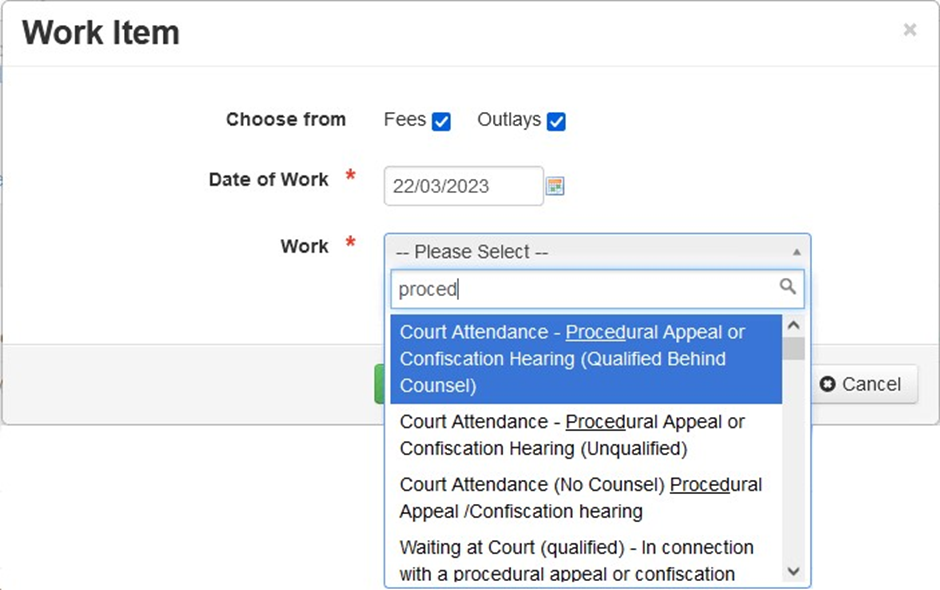
Where you are charging for the work that is chargeable under Schedule 1A, Part 1 (detailed fees) you should use the work items that have been designed specifically for those cases.
In addition, there is also provision to pay for “exceptional research”.
Legal research is not usually allowable on assessment because solicitors carrying out work are assumed to have sufficient expertise in the relevant areas of law in which they practice and researching the law is not ordinarily specific to the immediate matter or case in hand. As such it will often be considered as part of the overheads of the solicitor in developing their own knowledge of that area of law.
However, Paragraph 17 of the Notes on the operation of Schedule 1A, allows for the payment of detailed fees for time spent in researching a novel, developing or unusual point of law but only where the following conditions are met. That is:
and
As the provision specifies it is a matter for the Board to determine whether both of those tests have been met.
An example where exceptional research may apply is where there is very little or no previous case law and it has been necessary to consider English or European case law to formulate any submissions being made to the court.
It is recommended that you make an application to us before the work has been done as this will avoid difficulties at the accounting stage. Applications should be made to the Accounts Specialists and should be sent by email. You can find more details in our legal aid guidance section.
Finally, Regulation 7A of the Criminal Fees Regulations makes provision for detailed fees, where the Criminal Applications Department approve the case as exceptional, in circumstances where an assisted person would otherwise be deprived of the right to a fair trial in a case because of the amount of fees payable to the solicitor in accordance with Schedule 1A, Part 2.
Where that arises no block fees are allowed and all fees are calculated in accordance with Part 1 of the Table of Fees (detailed fees). This applies even where there is a transfer of solicitor and in such cases all solicitors must charge on the basis of detailed fees.
Paragraph 4 of the Notes on the operation of Schedule 1A, prescribes fees which are not chargeable in a case. For example:-
The full list as specified in paragraph 4 is not intended to be an exhaustive list of work items that are not chargeable. An assessment officer has discretion to disallow charges where they do not appear to be reasonable based on the information available.