
https://www.slab.org.uk/corporate-information/publications/corporate-information/legal-aid-reform/
https://www.slab.org.uk/corporate-information/publications/corporate-information/legal-aid-reform/

This section has information on how we support Legal Aid Reform, including:
Our role in legal aid reform is to provide advice to the Scottish Government.
The Scottish Government is responsible for legal aid policy.
SLAB administers the legal aid system and provides advice to Ministers on the operation of legal aid and how it can be improved to help them make policy decisions.
Our primary purpose is to manage access to legal aid funding. We do that through assessing eligibility for legal aid and paying accounts submitted for payment by solicitors and advocates.
We also directly deliver a range of legally aided services through our own network of employed criminal and civil solicitors and grant funded services.
These functions mean we have data and evidence that can inform our advice to Ministers.
Our stakeholder engagement work is being delivered on behalf of Scottish Government to allow us to give better advice on legal aid reform.
Legal aid reform has been at the forefront of our thinking since the independent strategic review of legal aid.
This section charts the key moments since the publication of that report.
Rethinking Legal Aid – an independent strategic review – February 2018
Scottish Government response to the Independent Review of Legal Aid in Scotland – November 2018
Scottish Government consultation – June 2019
Chief Executive calls for reform of legal aid – Herald Scotland 21 November 2024
Chief Executive’s statement on the need for reform in SLAB’s annual report 2024-25
Scottish Government paper – Legal Aid reform: discussion paper – February 2025
Chair’s response to Legal Aid Reform: discussion paper – February 2025 – noting SLAB provided advice to Scottish Ministers on the content of the paper.
Report on the Equalities, Human Rights and Civil Justice Committee inquiry into Civil Legal Assistance in Scotland – September 2025
We have set out here our position on key Legal Aid Reform topics, including why change is needed and what that change could look like. We will build on this information as the reform process continues.
The legal aid system in Scotland has evolved to some extent in response to the changing demands placed upon it, but it is nevertheless limited in its ability to adapt to a world not envisioned when it was created in its current form almost 40 years ago.
The current system is complex and hard to navigate. It isn’t person centred. There is no mechanism for connecting those in need with solicitors or advice agencies that can help them, and no guarantee that services with sufficient resources will be available to provide help.
Equally, the current system has limited scope for targeting resources at priority issues or securing services in any given place or for a particular type of problem.
Add these weaknesses to the challenge of ensuring that delivering legal aid funded services remains a sustainable economic prospect for providers, and change is undoubtedly needed.
We need a transformational bill to reshape the legal aid system as a public service. To shift the emphasis towards a strategic, proactive, needs-based, user- and outcomes-focused approach.
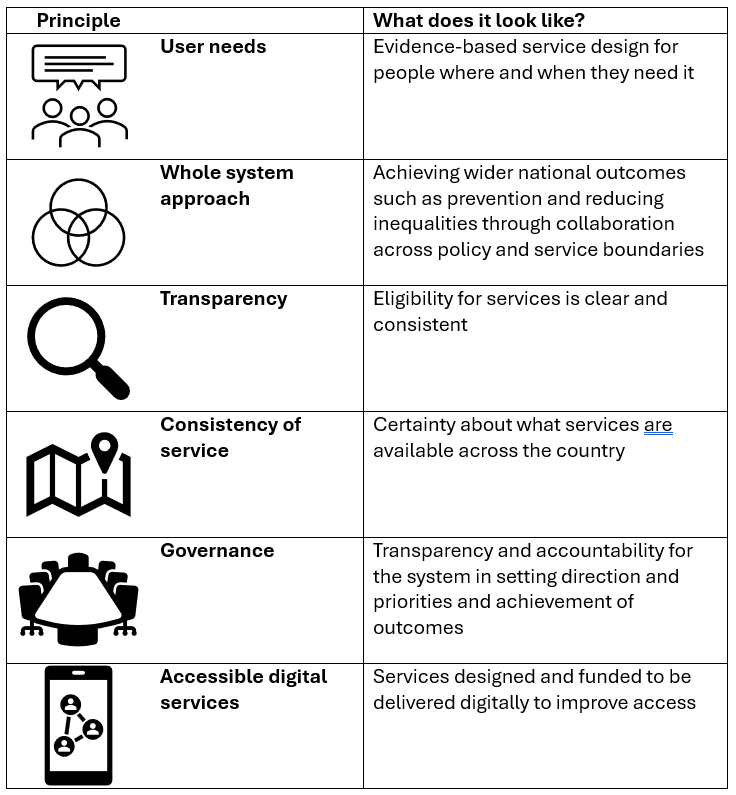
A statutory stated purpose or objectives for this substantial public fund.
This would enable the system to provide services designed with peoples’ needs at the forefront and clearly focused on delivering stated outcomes.
This section looks at:
The statutory framework for legal aid enables payment out of the Legal Aid Fund by way of three different funding mechanisms:
Solicitor firms register to be able to access public funds for legal work.
There is no requirement for a registered provider to commit to or carry out any specific scope or amount of publicly funded work for any particular area, topic or population group,
Legal aid in Scotland is primarily delivered through judicare funding for services provided by solicitors and others instructed by them, such as advocates and experts.
Most services paid for through the Legal Aid Fund are delivered by judicare through the private sector.
Our own employed solicitors also deliver legal representation services but on a much smaller scale.
A small amount of legal aid funding also provides grants for services through the third sector to deliver targeted legal and advice services.
With judicare as the main funding model, the system is shaped by the decisions of individual practitioners and firms as to which cases they will take on, what subjects they will cover and what volume of business they will undertake.
Judicare itself is tightly defined by complex and varied rules, requiring primary and secondary legislation to amend its operation significantly.
Legal aid reform can build on the strengths of the judicare model.
We know that the professions value judicare’s flexibility but desire less bureaucracy- and are keen to explore and understand the benefits that could come from grants or other commissioning models.
In future, we would have varied, complementary funding models to meet strategic priorities and people’s needs: directly employed solicitors, grants, commissioned services and judicare.
A successful public service system relies on planning, evidence gathering and analysis, strategic development and review.
Without a framework for this, feedback from users and other stakeholders has no strategic route to be assessed or acted upon.
It also limits the capacity of a government or funding body to be able to properly assess the impact and outcomes of investment in that service.
There are key elements to a framework for decision making, including:
These should be enacted cyclically so constant improvement and evidence-based decision making can be made.
Details of the activity currently underway.

We’ve been working with stakeholders across the legal and third sectors to explore how existing legal aid funding tools can be used more flexibly as part of legal aid – long term reform.
This engagement will shape the advice we’ve been asked to provide to the Scottish Government on legal aid long-term reform.
Our approach has been designed to involve stakeholders early, build a strong evidence base and encourage collaboration across diverse groups.
By tailoring engagement to different roles and levels of expertise, we helped create meaningful dialogue and ensured each group could contribute effectively.
As part of this first phase of engagement, we examined how current funding tools operate in practice, where flexibility exists and how these tools might support testing and trialing potential changes.
This work also helped us understand stakeholders' appetite for change and gather ideas for improving funding approaches under wider reform.
We began with a well‑received introductory “top session,” bringing together representatives from the legal profession, third sector, and academia.
Participants welcomed the opportunity to engage early and shape the direction of reform.
A series of targeted workshops followed each designed for groups with specific experience of funding methods.

These sessions explored how different tools are used, individually and in combination, where they add value, and how they might be adapted or combined to better meet future needs.
Across all workshops, participants shared commitment to working together as work under legal aid reform progresses.
There was clear interest in exploring more flexible mixes of funding, particularly how judicare and grant funding can be combined to improve services.
Participants highlighted how judicare underpins case by case provision, with grant funding supporting more strategic objectives.

Participants were open to discussing a more flexible or “high‑trust” approach as a method of optimising judicare, focusing on rebalancing responsibilities and controls amongst funder and provider.
Many felt such a funding tool could reduce administrative pressure and could potentially be piloted using existing data and audit processes.
There was a consistent desire for practical progress and momentum.
Across the sessions, a mix of funding methods was viewed positively.
Judicare was seen as essential for filling gaps that grants can’t cover, while grant funding was valued for its ability to support strategic and preventative work.
Participants also noted that grant funding can support wider and more collaborative partnership work, which may improve the client pathway and allow partners to utilise their expertise and maximise capacity by outsourcing and sharing the work with other organisations or firms as part of a network or partnership.
There was strong interest in exploring some of our grant funding powers, which haven’t been used to date, for example grant funding for children’s legal aid.
Strong interest in exploring partnership models, between advice agencies and private solicitor firms was also expressed, as well as some stakeholders have asked for more information on our funding powers for Advice & Assistance for advice agencies.
Stakeholders were interested to find out more about areas grant funding can support and have asked for more information and guidance.
Finally, while there was clear opposition to contracting, particularly due to negative associations with the England and Wales model, however, participants suggested to remain open to further exploration, despite initial hesitation.
This would require significant evidence‑gathering and careful exploration before approaching this subject again.
Stakeholders expressed a willingness to contribute to wider legal aid reform and welcomed the idea of viewing funding mechanisms as individual tools within a toolbox which can be used individual or in combination
This phase will conclude with a “tail session,” bringing stakeholders back together to reflect on progress and share key messages that will inform our advice to the Scottish Government.
This presentation is being used at our workshops on funding tools:
We are part of the Independent Fee Review Mechanism Group, which is examining the fundamental changes required to create a legal assistance system fit for the 21st century, including developing a more transparent, evidence based and sustainable approach to reviewing legal aid fees.
Details of activity completed to date:
Video and webinars on Children’s reforms coming into effect 1 June 2026 – Scottish Legal Aid Board – May 2026
Please contact us by email if you would like more information or speak with us about any aspect of Legal Aid Reform.