
https://www.slab.org.uk/solicitors/forms-and-declarations/legal-aid-online-declarations/collecting-equality-data-guidance-for-solicitors-delivering-legal-aid/
https://www.slab.org.uk/solicitors/forms-and-declarations/legal-aid-online-declarations/collecting-equality-data-guidance-for-solicitors-delivering-legal-aid/

This section provides information about:
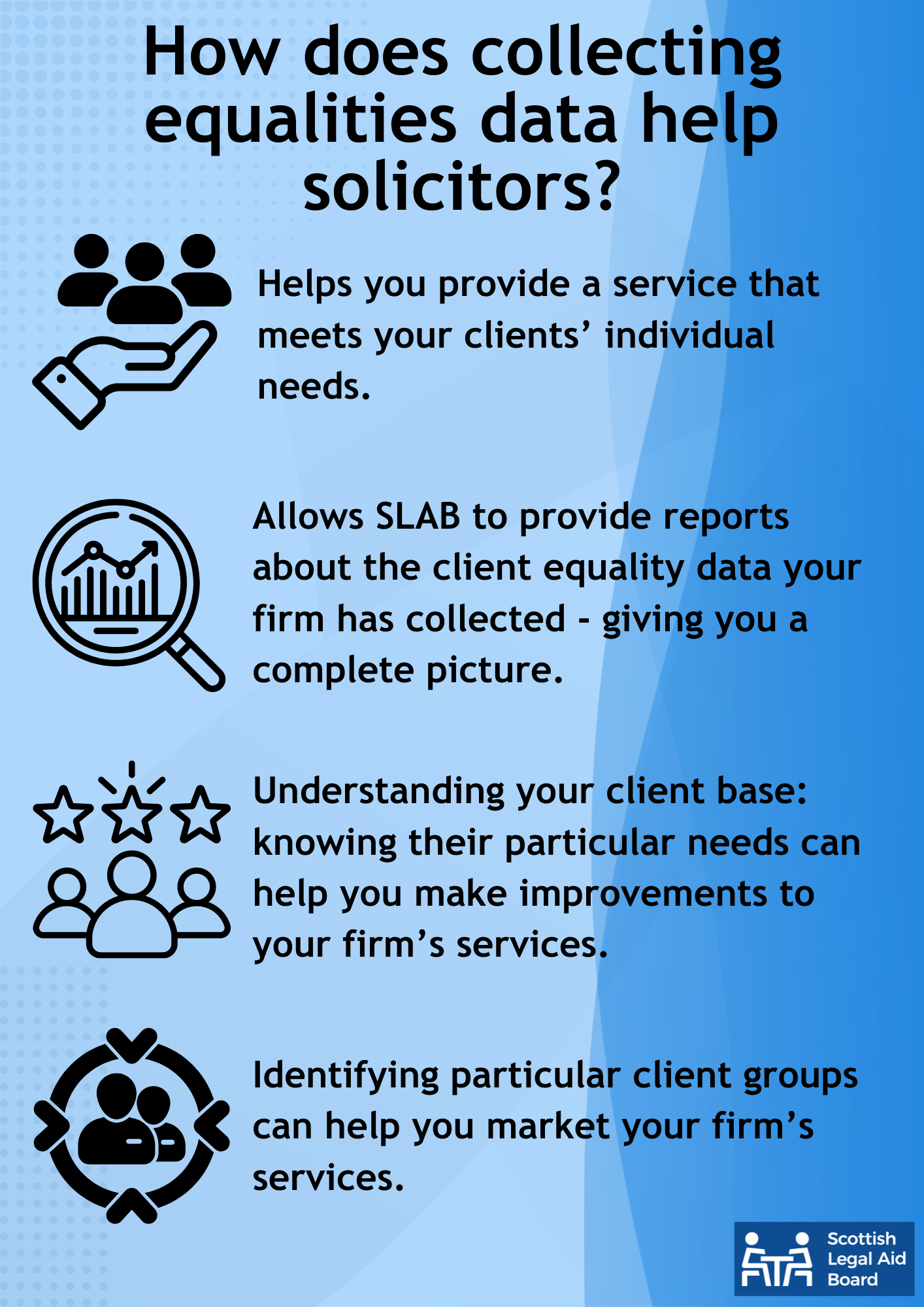 Collecting and reviewing data about your clients helps you provide a service that meets your clients’ individual needs.
As well as being able to view the data at an individual client level, we can provide you with reports about the equality data your firm has collected about all your clients, so that you can get a complete picture.
Understanding more about your client base and whether they have particular needs can help you make improvements to your firm’s services.
Knowing whether there are particular groups who frequently come to you for advice can help you market your firm’s services.
More information on creating accessible services is available from the Law Society of Scotland.
Equality data is important evidence that we use to highlight issues about the operation of legal aid and to advise the Scottish Government about the reform of legal aid. Reforms will bring improvements to you and your clients.
The data helps us to meet the Public Sector Equality Duty and our work as a listed public authority under the Equality Act 2010 (Scotland) (Specific Duties) Regulations 2012, as well as the United Nations Convention on the Rights of the Child (Incorporation) (Scotland) Act 2024.
Currently, we receive a response to the equality questions in a third of applications: a big increase on 4% a few years ago.
However, only 10% are fully completed.
This is too low and does not give us sufficient equalities data about who is applying for legal aid.
We publish high level equality data on our website that shows the demographics of people who access legal aid. This can be used by other organisations and individuals. We also publish Equality Impact Assessments (EqIAs) and Children’s Rights and Wellbeing Impact Assessments (CRWIAs), and applicants’ data is used to assess the impact of our policies on equality groups.
We do not use the equality monitoring data to make decisions about individual applications for legal aid.
We collect data on age, sex, disability, race (national identity and ethnic group) and care experience. We think this data is most relevant and proportionate to the services we provide.
Our privacy policy describes how we collect and use personal data, including equality data. See our privacy policy.
In line with EHRC and Scottish Government guidance, we aim to collect equality data from every applicant over the age of 12 years.
We understand that it can be challenging to ask your client for equality data. People in need of help from a solicitor are generally going through a difficult time in their life and their priority is to find a solution.
However, we know from research with solicitors that people are generally willing to provide equality data when asked.
Please see a script that you can use to ask your clients the equality questions.
We recommend you use this or adapt it for your own service.
Step 1: Share the ‘Applicant information about equality data’ guidance with your client. This explains why we collect equality data, what equality data we collect, and how we store it.
Step 2: When to ask for equality data: It may be easier to ask your client for equality data at an initial meeting or soon thereafter, and while you are completing the rest of the legal aid application. How you do this depends on your service and your client, and may include:
Step 3: You should explain that they can answer ‘prefer not to say’. If they need assurance about how we use and store this data, please use the information in this leaflet or in the ‘Applicant information about equality data’.
Step 4: Ask your client each of the equality questions in turn and record the answers on the declaration, directly into Legal Aid Online or whichever method suits you best. If you have some client equality data already from another source, then you should check this information is still accurate and that your client agrees to that data being shared with us.
Step 5: Enter the equality data in Legal Aid Online, if you haven’t already done so.
Most solicitors ask for equality data at the first meeting with their client. Some solicitors send a copy of the declaration to their client in advance of a first meeting so that the client sees the equality data questions in advance.
It is important to check that your client is happy to share their equality data with us and that it remains accurate. This will also ensure you comply with data protection legislation.
You should still explain to your client why we ask for this information (see “Why we need to collect equality data” above) and then you can use the data you have been given to confirm the information is correct.
For example, when asking about Sex you could say, "the [organisation who gave you the data] has told us your sex is male. Is that correct?”
It is important that your client knows that they have the option to answer ‘prefer not to say’ for all the equality questions apart from age.
You should reassure your client that equality data is not seen by our employees who assess individual applications. You can also remind them that we ask the equality questions to:
The only information our employees will see for each application is age or date of birth. In addition to the reasons above, we use this information to:
You are applying for legal aid for your client, and the equality data questions are part of the application process.
You can also verify that this data is from the applicant. We do not have the direct relationship with an applicant.
The return rate is unlikely to increase if we asked applicants after they had applied for legal aid, when most applicants have no ongoing relationship with us.
There is also no current technological solution open to us to gather the data directly.
No. Legal Aid Online has been updated to hold your client’s information in one place for multiple applications.
You should check that the equality data is up to date for each application, especially if it has been a while since your client’s last application.
Please contact us at equalities@slab.org.uk for more information or to discuss our approach to equality monitoring.