
https://www.slab.org.uk/corporate-information/publications/corporate-information/annual-reports/
https://www.slab.org.uk/corporate-information/publications/corporate-information/annual-reports/

Every year we lay our annual report before the Scottish Parliament and publish it on our website. The Annual Report and Accounts includes performance and accountability reports as well as the financial statements.
For this year, we have again published a summary on this page of our most recent Annual Report and Accounts, with the full documentation in PDF.
Please see the links below for the full downloadable report, key statistics, profession earnings, and news release.
Our previous two years’ reports and documents are also available. If you are looking for older reports, please contact us by email.
The following is a summary of our Annual Report and Accounts for 2024-25.
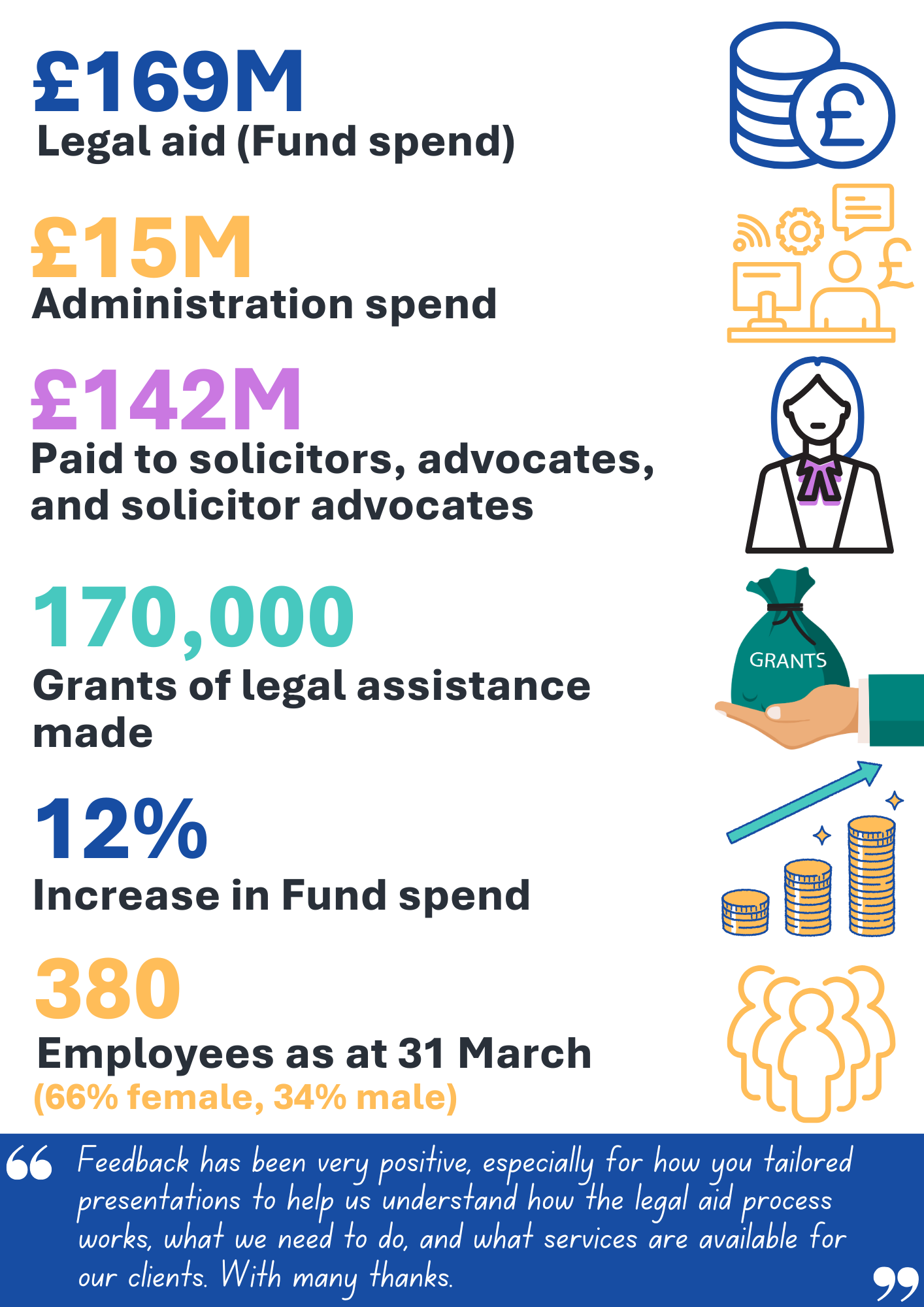
The chart on page 18 of the Annual Report details cash spent for legal aid, as this is the basis on which funding is received from Scottish Government.
The total cost of legal assistance between April 2024 and March 2025 was £169 million.
This is a 12% increase on 2023-24 and a 25% increase on 2022-23.
Expenditure increase has been driven by the uplift in criminal expenditure, linked to the expansion nationally of the Summary Case Management project, where we have seen a large increase in the cost of criminal ABWOR. There have also been increases across all areas of civil costs as the cumulative effect of recent years’ fee increases is now being seen in accounts received and processed.
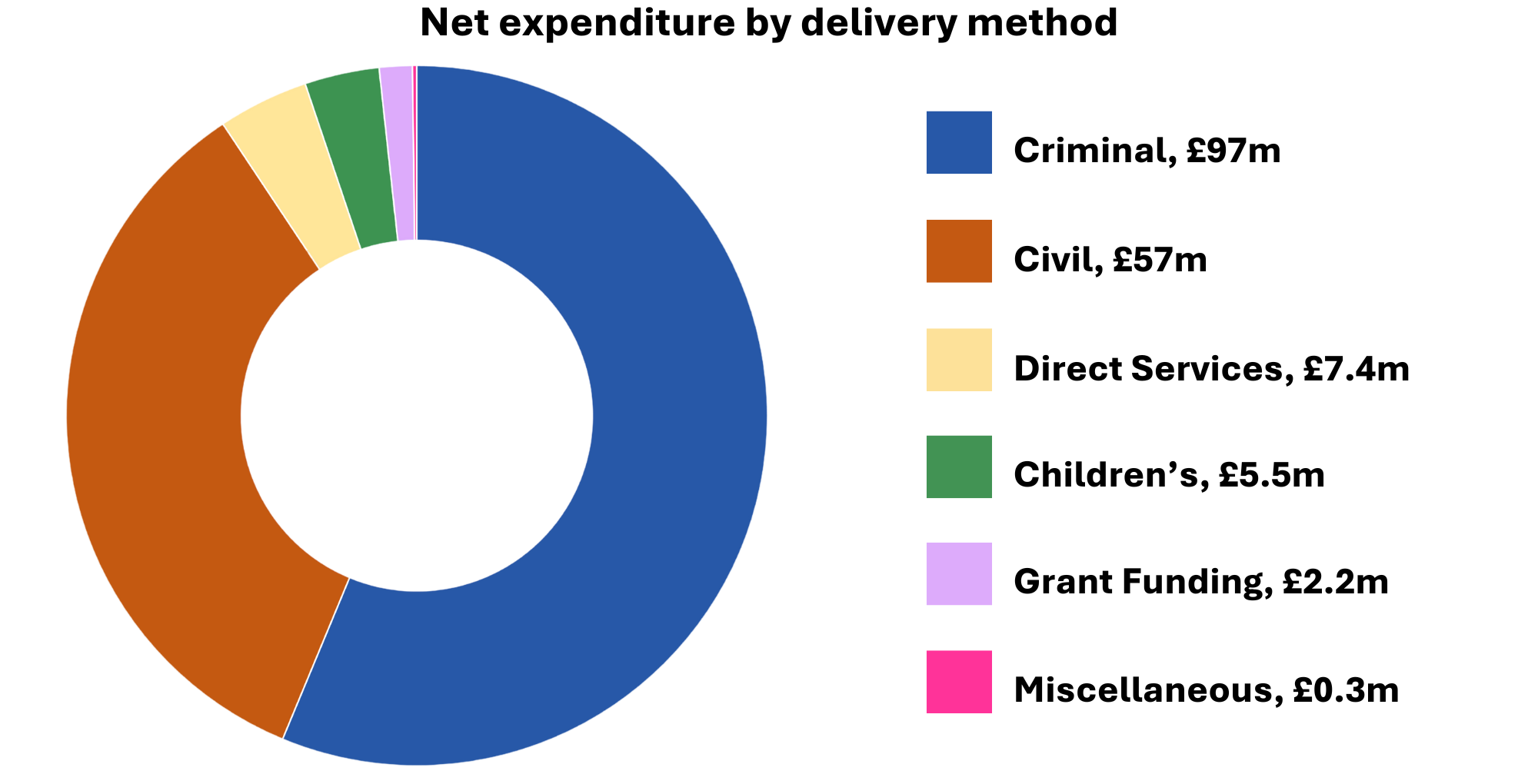
Due to the demand led nature of the Legal Aid Fund, the budget from Scottish Government is not capped. We are allocated a budget by Scottish Government annually, which is adjusted accordingly in line with forecast demand. In 2024-25 our allocated budget, after Scottish Government’s spring-budget-revision, was £173 million, and the final year end spend was £169 million.
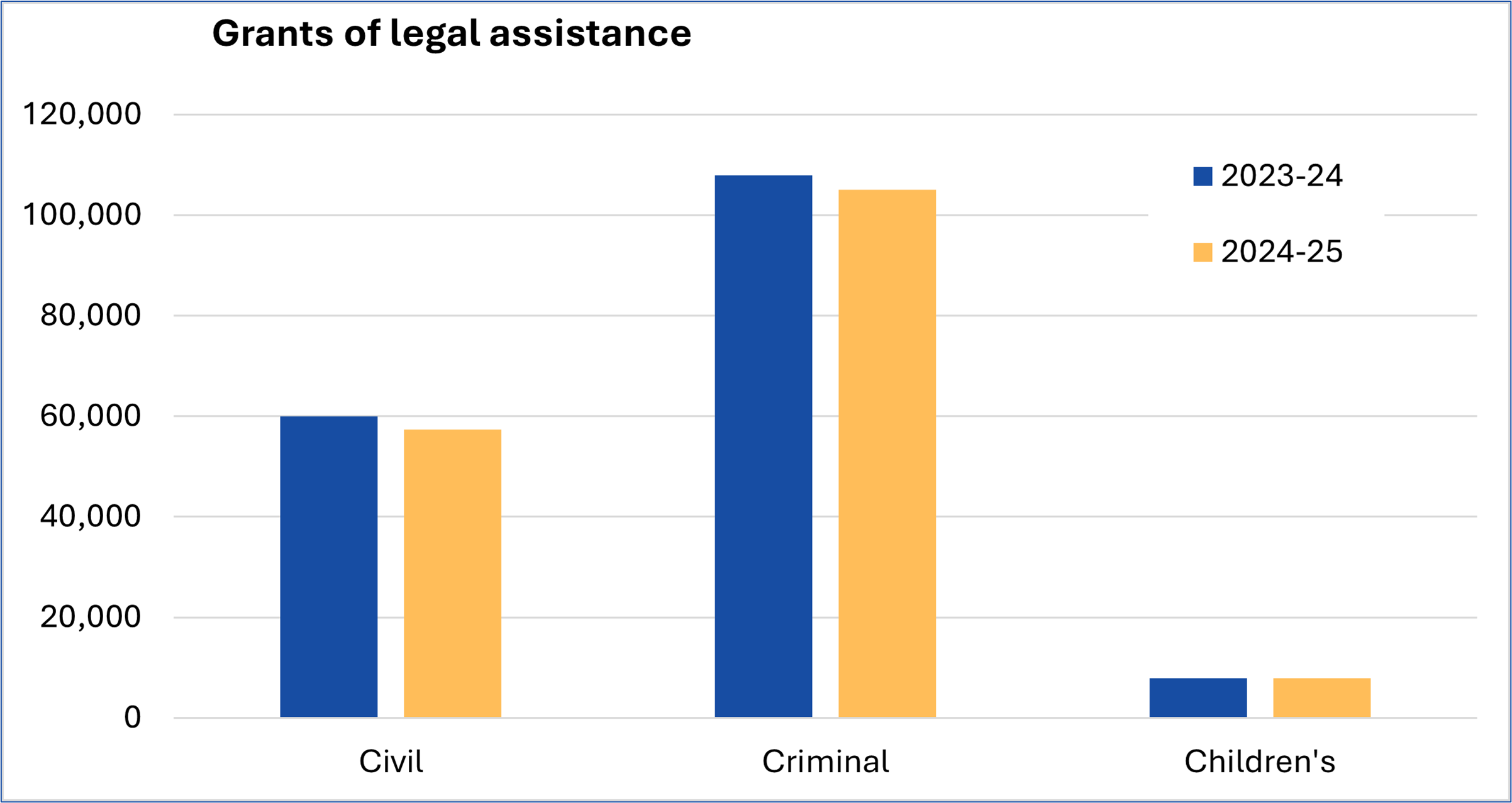
Total grants of legal assistance decreased by 3% to 170,000 as post Covid-19 surges subsided. The fall occurred in both civil (down 4%) and criminal (down 3%) legal aid, but children’s legal aid saw a 1% rise in grants.
Civil advice and assistance (A&A) saw constant levels in immigration, nationality & asylum, and mental health; all other areas of civil A&A declined.
Civil legal aid saw declines in non-family (down 7%) and in adults with incapacity (down 2%).
Family civil legal aid was level overall but some areas, primarily children focused, have seen increases in the number of grants made.
In criminal, the expansion of the Summary Criminal Case Management programme across Scotland is thought to be the reason for grants of ABWOR (assistance by way of representation), primarily used for guilty pleas in summary cases, increasing by 7% to 27,000.
Grants of summary criminal legal aid decreased by 7% to 36,000; the overall volume of ABWOR and summary legal aid decreased by 1%. This overall decrease in summary is not unexpected given the courts registered 5% fewer summary complaints in 2024-25.
Grants of solemn criminal legal aid decreased by 9% to 11,000 as the surge from the backlog clearing subsided. The level of solemn grants pre Covid-19 in 2019-20 was also 11,000.
In children’s legal aid, there were slight increases in the levels of children’s A&A and sheriff court grants.
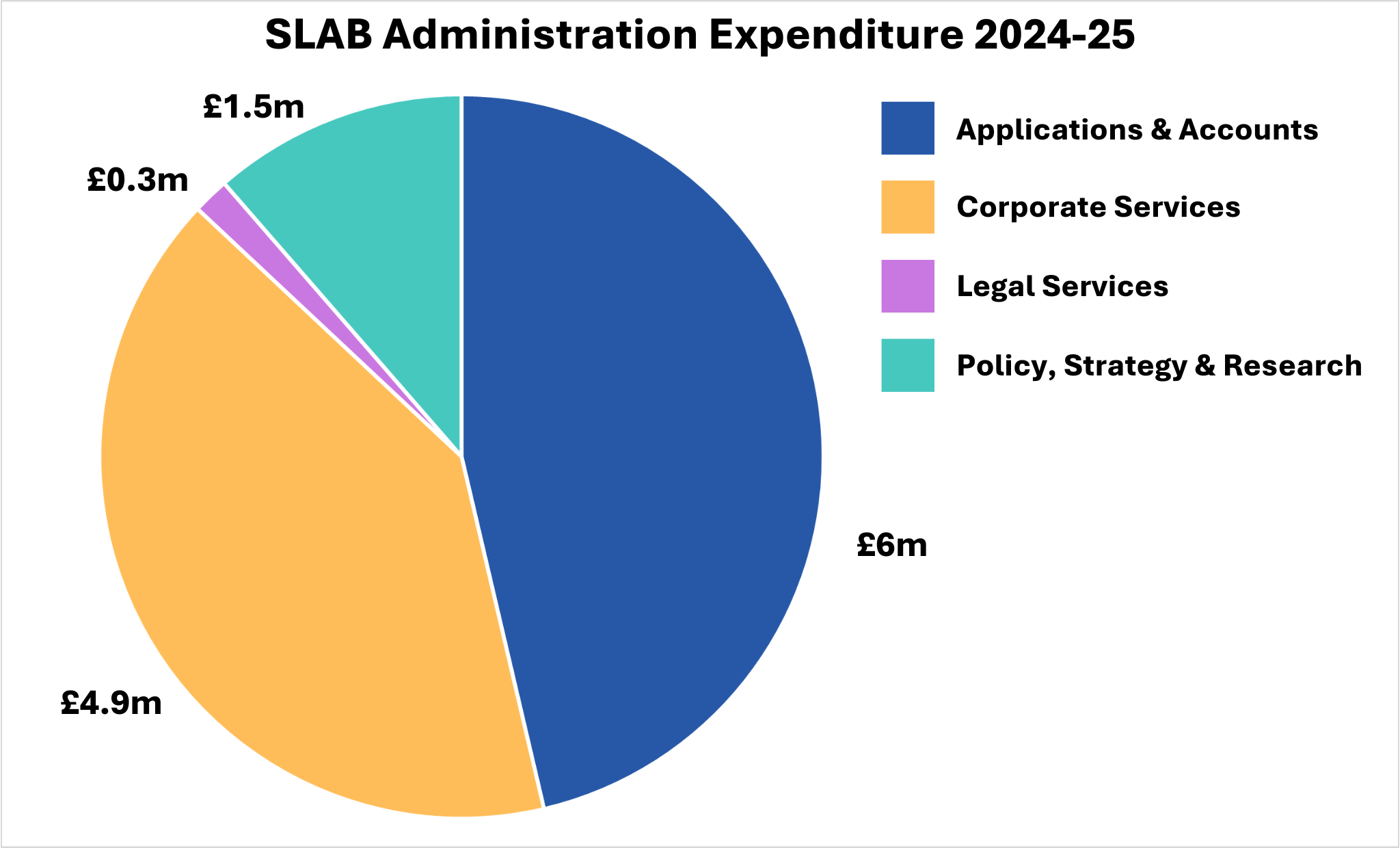
Our Administration budget is distributed across three main Directorates and a central team comprising the office of the Principal Legal Advisor which provides legal support and advice across the organisation.
Our main costs are related to activity in assessing the applications and accounts we receive and corporate services to support the organisation. This includes our own in house technical team to assist with and develop our Legal Aid Online platform as the main interface with solicitors for application and account processing.
As the chart above shows, a significant amount of administrative expenditure (£6m) is directed at ensuring legal aid expenditure is in accordance with prevailing statutory provisions, regulations, fee tables and taxation standards.
We have 33 Key Performance Indicators (KPIs) in the applications and accounts operational areas. Details are published on our website in our quarterly SLAB Operational Performance Overview Reports (SOPOR).
Performance for each of these is measured against their own benchmarks. The benchmarks can be adjusted each year according to the aims of the business and the wider operating environment.
The KPIs are designed to promote the timely and effective handling of applications and accounts with an emphasis on ‘getting it right first time’. A high initial grant rate, or payment in full rate, is of benefit to stakeholders (the legal profession, assisted persons and the justice system) as well as us for improving the efficiency of our administration.
Of the 33 KPIs, nine (two Applications’ KPIs and seven Accounts’ KPIs) had periods of ‘worse than’ within the year, due to resourcing challenges, however performance did improve and the vast majority of KPIs fall into the ‘better than’ or ‘met’ category.
In applications there are 14 KPIs.
In 2023-24 the aggregate performance was 81%.
In 2024-25 the aggregate performance improved markedly to 96%.
Six benchmarks were made more challenging in 2024-25. Three benchmarks, in solemn applications, were relaxed slightly due to the difficult conditions in 2023-24, including the surge of cases due to backlog clearing in the criminal justice system at that time.
In accounts there are 19 KPIs.
In 2023-24 the aggregate performance was 80%.
In 2024-25 the aggregate performance improved to 85%.
There were several challenges in the delivery of accounts benchmarks, but huge efforts were made to turn performance around. Accounts have been investing in cross-training across teams and load balancing across the whole department. The criminal teams also dealt with the increase in the volumes of accounts due to the backlog clearing within the justice system.

 We have been developing a Customer Insight Strategy.
The strategy will enable us to better target changes to our policies and procedures and inform our indicators of performance. It will be finalised early in 2025-26.
We have made changes to our internal systems to create more accessible and user-friendly procedures that enable quicker processing of decisions.
We moved a range of application types onto our new systems platform in June 2024 and March 2025.
We continued our review of financial eligibility assessment in civil legal assistance.
Our advice to Scottish Government on the development of standardised discretionary allowances in the assessment of applicants’ disposable income resulted in the proposal being included in their legal aid reform discussion paper published in February 2025.
We published a Vulnerable Customer Policy.
The policy sets out how we will deal with our customers who identify as vulnerable.

 We have been reviewing delivery models for our direct legal services to respond to contextual changes.
We successfully piloted a law student internship, with a second opportunity being offered in 2025-26. We embedded a framework to facilitate shadowing for individuals interested in pursuing a career in legal aid work. We established a Client Legal Services’ traineeship, drawing on our unique position as Scotland’s largest legal aid provider by offering experience of civil and criminal law.
We have continued to grow our national influence through responding to consultations and being key players in pilots of new ways of working.

 We have carried out a review of our staff pay and grading structures.
We reviewed our staff performance management policy and will consult with staff in early 2025-26.
We ran a 12-month leadership programme for senior managers.
Forty-six of our staff completed the 12-month development programme, and learning has been put into practice through peer-to-peer support and project work.

 We developed our approach to workforce planning to ensure our staff have the skills and resources needed to deliver future responsibilities.
We agreed a methodology for our approach to a corporate workforce plan, with several workshops held with Directors throughout the 2024-25 period.
Scottish Government has stated that it intends to reform legal aid in Scotland.
We have continued to assist with advice on options for reform to enable Ministers to make decisions about the future. This advice was instrumental in the publication of Scottish Government’s legal aid discussion paper in February 2025.
| File | Type | Size |
|---|---|---|
| Annual Report 2024-25 | 3 MB | |
| Annual Report 2024-25 News release | DOCX | 56 KB |
| Advocate earnings 2024-25: Top 20 | 63 KB | |
| Advocate earnings 2024-25: Alphabetical order | 217 KB | |
| Firm earnings 2024-25: Top 20 | 64 KB | |
| Firm earnings 2024-25: Alphabetical order | 853 KB | |
| Solicitor Advocate earnings 2024-25: Top 20 | 64 KB | |
| Solicitor Advocate earnings 2024-25: Alphabetical order | 112 KB | |
| SLAB Annual Report 2024-25 Appendix 1: Key Statistics | 528 KB | |
| SLAB Annual Report 2024-25 Appendix 2: Civil legal assistance | 277 KB | |
| SLAB Annual Report 2024-25 Appendix 3: Criminal legal assistance | 234 KB | |
| SLAB Annual Report 2024-25 Appendix 4: Children's legal assistance | 117 KB | |
| SLAB Annual Report 2024-25 Appendix 5: Analysis of payments | 201 KB | |
| SLAB Annual Report 2024-25 Appendix 6: Client Legal Services | 60 KB |
| File | Type | Size |
|---|---|---|
| SLAB 2022-23 Annual Report and Accounts | 4 MB | |
| SLAB Annual Report news release 2022-23 | 84 KB | |
| SLAB Annual Report 2022-23 Appendix 1: Key Statistics | 560 KB | |
| Advocate earnings 2022-23: Top 20 | 164 KB | |
| Advocate earnings 2022-23: Alphabetical order | 449 KB | |
| Firm earnings 2022-23: Top 20 | 418 KB | |
| Firm earnings 2022-23: Alphabetical order | 469 KB | |
| Solicitor Advocate earnings 2022-23: Top 20 | 421 KB | |
| Solicitor Advocate earnings 2022-23: Alphabetical order | 406 KB |